Imagine an intruder who does not break a window. Instead, they quietly walk in using a key they stole weeks ago, wander the building for a month learning where everything is, and only then make their move. Traditional antivirus is a lock on the front door. It does nothing about the intruder who already has a key and is patient enough to wait. That is exactly how modern cyberattacks work, and it is why more and more small businesses are asking whether they need Managed Detection and Response, or MDR.
It is a fair question. MDR was once seen as enterprise-only, something for companies with big budgets and dedicated security teams. That has changed. This guide is written for the small business owner trying to decide whether MDR is worth it, including many here in the Tulsa area weighing exactly this question. We will cover what MDR actually does, why traditional antivirus alone no longer cuts it, and how to tell whether your business genuinely needs it.
First, What Is MDR?
Managed Detection and Response is a security service that continuously monitors your systems for threats, detects malicious activity, and responds to it, all backed by a team of real security experts. Where traditional antivirus simply tries to block known bad files, MDR watches for suspicious behavior across your devices, investigates what it finds, and takes action to stop an attack before it spreads through your business.
The key is the combination of technology and people. Automated tools are excellent at flagging potential problems, but they cannot investigate a murky situation, make a judgment call, or hunt for a threat that is deliberately hiding. A skilled analyst can. MDR brings both together: powerful software to catch the signals, and human experts to interpret them and act. That is the difference between an alarm that beeps and a security team that responds.
Why Traditional Antivirus No Longer Protects a Small Business
For years, traditional antivirus software was the cornerstone of business security, and it still has a role. But on its own it leaves dangerous gaps, because it was designed for a different era of threats. Traditional antivirus works mostly by recognizing known bad files. Modern attackers have simply stopped relying on those.
Today’s intrusions often use techniques traditional antivirus was never built to catch: stealing legitimate employee credentials and logging in like a normal user, hiding inside trusted software, or moving quietly through a network for weeks before striking. There is no obvious malicious file to flag, because the attacker is using your own tools against you. Think of traditional antivirus as a smoke detector. Useful for sounding an alarm, but it cannot investigate why there is smoke, and it certainly cannot put out the fire. MDR is having both the detector and a trained response team on call at all hours. For a business, that difference can mean catching an intrusion in minutes instead of discovering it months later in a headline.
The clearest way to see the difference is side by side:
| Traditional Antivirus | MDR | |
|---|---|---|
| Approach | Blocks known bad files | Detects suspicious behavior |
| Stolen logins | Usually misses them | Flags unusual account activity |
| Investigation | None, just an alert | Human analysts confirm the threat |
| Response | Up to you | Team isolates and remediates |
| Coverage | Runs in the background | Monitored 24/7 by experts |
How MDR Works
While the technology under the hood is sophisticated, the concept is refreshingly straightforward. MDR generally works in four stages, shown below.
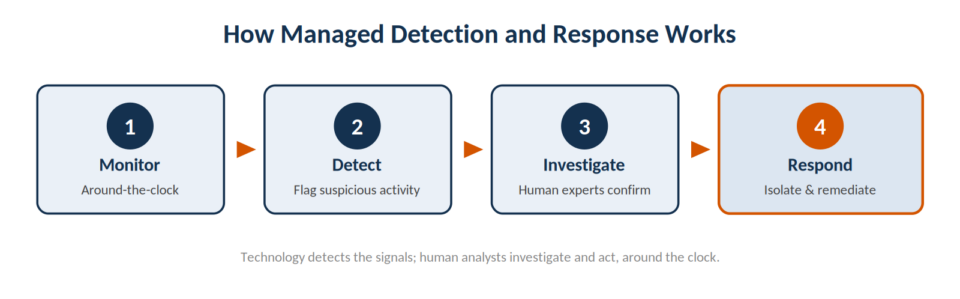
The four stages of Managed Detection and Response.
- Continuous monitoring. Lightweight software watches your endpoints and systems around the clock for signs of malicious activity, even at 3 a.m. on a holiday.
- Detection. When something suspicious appears, the system flags it and gathers the context needed to understand what is really happening.
- Expert investigation. A security operations center staffed by real analysts examines the threat, filtering out the false alarms that would otherwise bury your team and confirming genuine dangers.
- Response and remediation. When a real threat is confirmed, the team acts immediately to isolate affected systems, remove the threat, and guide recovery, before a small intrusion becomes a business-ending breach.
The Business Benefits of MDR
MDR delivers a level of protection most businesses could never build in-house:
- Around-the-clock coverage without hiring and staffing a full internal security team, which few small and mid-sized businesses can afford.
- Faster threat detection and response, which is the single biggest factor in limiting how much damage an attack can do.
- Fewer false alarms, because human experts filter the noise and escalate only what is real, so alerts do not get ignored.
- Support for compliance in industries with security and reporting requirements, where monitoring and response are increasingly expected.
- Genuine peace of mind, knowing skilled people are watching your business even when the lights are off.
How ArcLight Delivers MDR to Small Businesses
At ArcLight, small businesses get MDR through the ArcLight Security Suite, a layered endpoint security package sold in tiers so you buy the depth you need, priced per endpoint. Full 24/7 managed detection and response comes in at the top tier, and you can start lighter and step up as your risk grows, with no long-term contract required. Many IT firms will not take on smaller clients at all, and ArcLight was built to fill exactly that gap, making enterprise-grade protection genuinely accessible to a small business rather than only the large companies it was once reserved for.
The managed detection and response behind the Security Suite is built on an enterprise-grade platform trusted to protect millions of endpoints, paired with our own local, hands-on service. That means Tulsa-area businesses get world-class detection backed by a team down the road that actually knows your business, with continuous monitoring and expert remediation across your endpoints, while you focus on running your company.
MDR is one important layer of a complete security strategy, not the whole thing, and the Security Suite is designed to reflect that. You can start with foundational endpoint protection and step up to full managed threat hunting and 24/7 MDR as your needs grow, rather than committing to everything at once. It also works alongside the other fundamentals covered in our broader cybersecurity services, from proactive monitoring to security awareness training, and it supports the requirements many regulated businesses face, which we address under compliance.
Does Your Small Business Actually Need MDR?
Not every business faces the same risk, so here is an honest way to decide. Your small business is a strong candidate for MDR if any of these apply:
- You handle sensitive data, such as customer records, payment information, or health data.
- You face compliance requirements in your industry, where monitoring and response are expected or mandated.
- Downtime or a breach would be costly, which is true for most small businesses that cannot absorb days of disruption.
- You do not have in-house security staff, so no one is watching for threats around the clock.
If none of those apply, strong fundamentals like managed antivirus, backups, and multi-factor authentication may be enough for now. But for most small businesses handling real data or facing real compliance pressure, MDR has shifted from nice-to-have to a sensible baseline.
Getting MDR Without an Enterprise Budget
If your business handles sensitive data, faces compliance requirements, or simply cannot absorb the downtime and damage of a breach, and few small businesses can, then MDR is worth serious consideration. Cyberattacks increasingly target companies of every size, not just the giants in the news. The Cybersecurity and Infrastructure Security Agency urges organizations to adopt continuous monitoring and rapid response, which are precisely what MDR provides. And the FBI’s Internet Crime Complaint Center reported record cybercrime losses in 2024, a reminder that the threat is growing, not fading. MDR is no longer a tool reserved for large enterprises. It is becoming a baseline for any business that takes its survival seriously.
Frequently Asked Questions
Does a small business really need MDR?
It depends on your risk. Small businesses that handle sensitive data, face compliance requirements, or could not absorb the cost of a breach are strong candidates for MDR. Those with very simple setups may be fine with solid fundamentals for now, but MDR is increasingly a sensible baseline as threats grow.
What is MDR in cybersecurity?
MDR, or Managed Detection and Response, is a security service that continuously monitors your systems, detects threats, and responds to them, backed by human security experts. It combines advanced technology with a team that investigates and acts on real threats around the clock.
What is the difference between MDR and traditional antivirus?
Traditional antivirus tries to block known malicious files, while MDR watches for suspicious behavior across your systems, investigates it with human experts, and actively responds to stop attacks. MDR catches modern threats, like stolen credentials and hidden intrusions, that traditional antivirus is not designed to detect.
Do small businesses need MDR?
Increasingly, yes. Attackers target businesses of all sizes, and small businesses often lack the layered defenses to stop advanced threats. MDR provides enterprise-grade, around-the-clock protection without the cost of building an internal security team.
How does MDR respond to a threat?
When a genuine threat is confirmed, the MDR security team acts immediately to isolate affected systems, remove the threat, and guide remediation. This rapid, expert-led response limits the damage an attack can cause before it spreads.
Where can a Tulsa business get MDR?
ArcLight provides MDR to businesses across Tulsa, Broken Arrow, Owasso, and the surrounding communities, delivering enterprise-grade protection with a local team that knows the area and can respond hands-on when needed.
How does a small business get MDR from ArcLight?
ArcLight delivers MDR through the ArcLight Security Suite, a layered endpoint security package sold in tiers and priced per endpoint. Full 24/7 MDR comes in at the top tier, with no long-term contract required, so small businesses across Tulsa and beyond can get enterprise-grade protection without an enterprise budget.
Strengthen Your Security With MDR
Modern threats call for modern defenses, and hoping your traditional antivirus is enough is not a strategy. If you want to know whether your business is truly protected, or you are ready to add the round-the-clock coverage MDR provides, talk to the ArcLight team. We will help you build security that fits your business and your budget.
By Brian Largent, CEO & System Architect

Brian Largent
Father to five, husband to one, founder, CEO, and all around swell fella (or so I'm told)