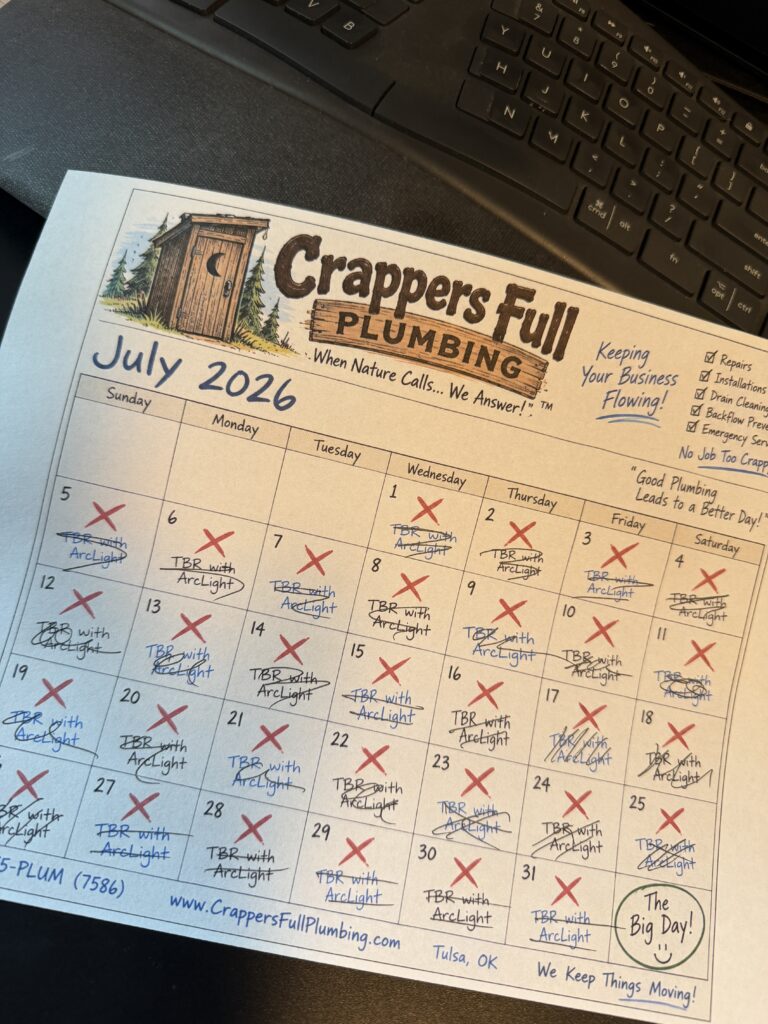
If you’ve felt like the IT support landscape in Tulsa has shifted under your feet, you’re not imagining it.
Over the past several years, multi-state and national managed service providers, most of them backed by private equity, have been buying up local MSPs at a remarkable pace. Many of our friendly, respected competitors (people we’ve shared panels, referrals, and the occasional beer with) have sold. Within the past three years alone, four of the largest MSPs in Tulsa were acquired.
Ask me how I know.
Because our prospect list has completely opened up. Businesses we’ve reached out to for years, the ones who always gave us a polite but firm “We’re very happy with XYZ MSP,” are now calling us back and saying, “Let’s talk.”
That’s good for ArcLight. It is not good for the businesses making those calls. So let’s talk about what’s happening, why it’s happening, and what you should do about it.
“Because They Know How to Make Money and You Don’t”
I was recently at an event in Florida hosted by a billion-dollar software company that serves the MSP industry. In one session, a leader from the private equity and acquisition world was in the room, and I got the chance to ask him a question that had been bugging me for a while:
“How do all these MSPs that get acquired and lose half their customer base due to poor service continue to prosper? How do they keep growing? Are they even growing?”
He crossed his arms, smiled, and said, more or less, “Because they know how to make money and you don’t.”
Fair enough. I run an MSP, not a hedge fund.
But from where I sit, I can see how the short-term math works. Buy a well-run local MSP at a high multiple. Consolidate the help desk into an out-of-state call center. Raise rates. Push tool bundles. Lock clients into long agreements. Cut headcount. Show a nice EBITDA number. Buy the next one. Repeat.
What I can’t see is how that works in the long term. When the model depends on acquiring new clients faster than you burn through the ones you have, it starts to look a lot less like a business and a lot more like a Ponzi scheme with a help desk.
What We Hear Every Week
I meet weekly with business owners and office managers who used to work with a local MSP and got absorbed into the Big MSP playbook. The details change. The story doesn’t.
- “We loved our tech, and now we never see them.” They used to call and get their person, the one who knew the quirky printer in accounting and the owner’s preference for a specific monitor setup. Now it’s a random technician every time. Every ticket, even on a recurring issue, starts from scratch.
- “We used to get live support. Now we wait.” They used to call in and get a real person with a quick fix. Now issues take hours to resolve, or days when a ticket climbs through multiple tiers of support.
- “Our rates went way up and our service went way down.” Dramatic price increases, paired with an equally dramatic drop in quality. That’s not a trade anyone agreed to.
- “Our bills are a mess and nobody can fix them.” Months spent trying to untangle billing errors. One prospect told me, “I ran all my bills through Claude.ai and it said my MSP owes me $8,000. They said they’d refund it, but that was weeks ago, so who knows.” When your clients need AI to audit your invoices, something has gone sideways.
- “Every week someone calls to scare us into buying something.” Near-weekly calls from account managers pushing another cybersecurity tool. The pitch is always the same: “If you don’t buy X, you’re going to get hacked.” Or, “If you don’t buy Y, we need you to sign a document accepting the risk.” The Fear, Uncertainty, and Doubt compounds almost daily.
The AI Problem
Many of the big players are adopting AI, and I’m genuinely a fan of AI done well. We use it at ArcLight. But a lot of what I’m seeing isn’t AI done well.
It’s AI forced onto clients as a way to reduce the MSP’s operational costs: chatbots in place of people, automated responses in place of actual answers. And some of these firms have the gall to add a line item to their client agreements for “AI-assisted support.”
Here’s how it should work. AI reduces cost for the MSP. When it’s properly implemented, it should also reduce cost for the customer through faster resolution, better documentation, fewer repeat tickets, and smarter technicians. That’s the deal. Charging clients extra for a tool that saves you money is backwards, and the fact that it’s common right now tells you a lot about whose interests are being served.
So Why Do People Choose Big MSP?
Honestly, we aren’t entirely sure. But here’s what we’ve been told when we competed against a Big MSP and lost.
- They’ve never had a Big MSP before. If you’ve never been through it, you don’t know what you don’t know. The sales process is polished. The onboarding is where reality shows up.
- The resume is impressive, on paper. Big MSPs are great at touting headcount and experience. “300 years of combined cybersecurity experience across 1,200 employees!” Do the math. That’s about three months each.
- They’ll sell at a loss and make it up later. Win the deal cheap, then upsell for months and years. Once you’re on a three- or five-year agreement, they have leverage. Either the price climbs, or service quietly gets cut back until you try to leave. And good luck with that. In our experience, terminating one of these agreements can drag on for months, and every one of those months is billable.
- They’ll remove competition at almost any price. If you run a professional MSP in a market Big MSP wants, expect to be undercut on every competitive bid. Or expect an offer to buy you out at a very large multiple of EBITDA. That’s tempting, unless you actually care about what happens to your clients afterward.
- They’re “local” now. The newest marketing move is to open an office in your city and call it local. There might be one or two onsite engineers. The help desk, the escalation team, and the people making decisions about your account are somewhere else entirely. A lease is not a local presence.
Why People Choose a Local MSP
- One throat to choke. It’s a crude expression, but it’s accurate. A good local MSP has a skilled team that gets to know your people, your systems, and your business. When something breaks, you know exactly who’s responsible, and they know you.
- You can reach the person in charge. At a small MSP, the owner is usually a phone call away. When there’s a problem, you’re not filing a complaint with a regional VP three states away. You’re talking to the person who can actually fix it and who personally cares that it gets fixed.
- Institutional knowledge stays with your account. Your tech remembers that the server in the back room needs a specific reboot order, that your CFO travels every third week, and that the last time the firewall hiccupped it was the ISP. That knowledge saves you time and money on every ticket.
- Onsite means onsite. When a local MSP says they can be at your office, they mean today, from across town. Not a dispatched subcontractor who’s never seen your network.
- No quotas driving the conversation. A good local MSP recommends what you actually need, not what’s on this quarter’s sales incentive sheet. If a tool doesn’t fit your risk profile, they’ll tell you, even if it costs them the sale.
- Flexibility over a playbook. Big MSPs run standardized playbooks because that’s how they scale. Local MSPs can adapt to how your business actually works, whether that’s odd hours, specialized software, or a regulatory requirement unique to your industry.
- Reputation is on the line. When you live and work in the same community as your clients, your name is your business. You see them at church, at the kids’ games, at the Chamber lunch. That kind of accountability doesn’t show up in a contract, but it matters.
- Reasonable agreements. A confident local MSP doesn’t need to trap you in a five-year contract with a termination maze. They keep clients by doing good work.
- Supporting your local community. Your dollars stay in Tulsa. They pay local salaries, support local families, and get reinvested in local businesses.
To Be Fair: It’s Not Big vs. Small
Are there good big MSPs? Yes, no doubt. Are there bad small MSPs? Absolutely. We’ve seen it all, and we’ve cleaned up after both. I wrote about how to evaluate an IT provider in more detail here: How to Choose an IT Company in Tulsa: A Practical Guide.
The most important thing isn’t the size of your MSP. It’s understanding your own business risk and support demand.
A hospital has an enormous need for rapid support. Minutes of downtime can affect patient care. A five-computer plumbing company, on the other hand, might be able to function without its computers for days.
I once had a small manufacturer tell me, “We don’t even need computers. Everything we need is in binders in a closet. If those were destroyed, I could pull a part from the field, get the specs off it, and build it again.”
That’s a serious edge case. But it’s worth noting, because it illustrates the point: FUD can getcha if you don’t know how to calculate your risk. If you understand what downtime actually costs you, what data you actually need to protect, and what your regulatory obligations actually are, no account manager can scare you into buying something you don’t need.
Questions to Ask If Your MSP Was Recently Acquired
If your IT provider was bought in the last few years, here are a few questions worth asking yourself:
- Do I still talk to the same people I used to?
- How long does it take to get a live human on the phone?
- Have my rates gone up, and has my service gone up with them?
- Do I understand my invoices, and are they accurate?
- When was the last time someone recommended something because it was right for us, not because it was on a sales sheet?
- Do I know how to get out of my current agreement if I need to?
If those answers make you uncomfortable, you’re not alone. And you have options.
What This Means for ArcLight
We’ve been serving Tulsa businesses for 18 years. We’ve watched good competitors sell, and we understand why. The offers are real, and they’re big.
But we built ArcLight to serve our clients, not to fatten up for a buyer. Our team knows your people and your systems. When you call, you get someone who can help, and when you need the owner, you get me.
If you’re one of the many businesses that went from “we’re very happy with XYZ MSP” to wondering what happened, we’d be glad to talk. No scare tactics. No five-year handcuffs. Just an honest look at your risk, your needs, and whether we’re a good fit.
Call us at (918) 270-6600 or visit arclightgroup.com.
ArcLight is on IT!

Brian Largent
Father to five, husband to one, founder, CEO, and all around swell fella (or so I'm told)