Ask a small business owner what an hour of downtime costs them and most will shrug. It feels like an annoyance, not a line item, a morning of frustration you push through and forget by Friday. But that shrug is exactly the problem. Downtime has a real, calculable price, and for a small business it is almost always higher than the owner thinks. The good news is that most of it is preventable, and preventing it is precisely what managed IT services are built to do.
This guide breaks down what downtime actually costs, then shows how managed IT services reduce downtime by heading off the outages that cause it, and what separates businesses that lose a fortune to outages from those that barely notice them.
What Counts as Downtime?
Downtime is any period when the technology your business depends on is unavailable. That is broader than a full-blown server crash. A frozen point-of-sale system, an email outage, a network that has slowed to a crawl, or a ransomware attack that locks your files all count. If your team cannot do their work, or your customers cannot do business with you, the meter is running, whether or not anything is dramatically on fire.
The Numbers Are Bigger Than You Think
The research on this is sobering, and it comes from serious sources. Gartner is widely cited pegging the average cost of IT downtime at roughly 5,600 dollars per minute across industries, which works out to more than 300,000 dollars per hour. That figure spans large enterprises, so it runs high for a small shop, but it establishes just how seriously the industry takes the problem.
The small-business-specific numbers are more grounded but still striking. Research from Datto, based on a survey of more than 1,000 managed service providers, has put the average cost of downtime for a small or mid-sized business at roughly 8,000 dollars per hour during an incident. Even at the smaller end, the losses add up fast, and studies consistently find the proportional hit to a small business is often worse than for a large one, because a small business has less cushion to absorb it. A lost day is a much bigger share of a small company’s month.
The Four Real Costs of Downtime
When owners do think about downtime, they usually picture a single repair invoice. But that invoice is the smallest part. The true cost has four components, and the ones you cannot see on a bill are often the largest.
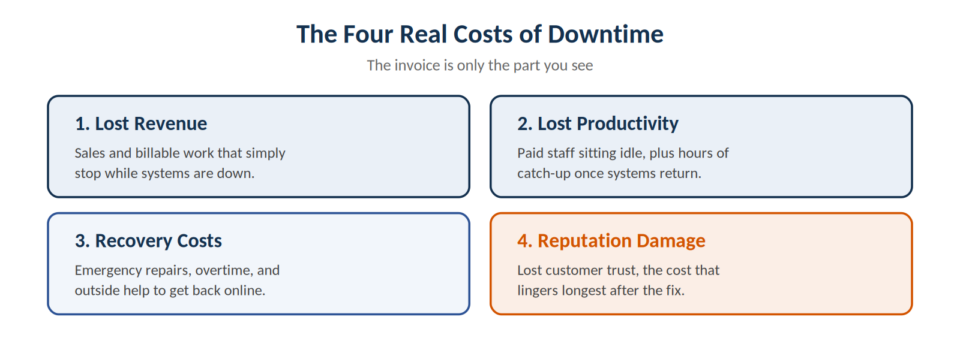
The four components of what an outage really costs.
1. Lost Revenue
When systems go down, revenue-generating work often stops cold. Sales do not close, orders do not process, billable hours are not logged. For any business where technology touches the way you make money, and that is nearly all of them now, every minute of downtime is a minute of income you do not get back.
2. Lost Productivity
Your team is still on the clock during an outage, still being paid, but unable to do their jobs. Worse, the cost does not end when systems come back. Research consistently finds that every hour of downtime creates additional hours of catch-up as work backs up and people scramble to recover. You pay for the outage twice: once while it happens, and again while everyone digs out.
3. Recovery Costs
This is the part most owners do picture: the emergency repair, the after-hours rates, the outside specialist brought in to put things right. When you are down and desperate, you pay premium prices for fast help. These reactive, emergency costs are almost always higher than the steady cost of preventing the problem in the first place.
4. Reputation Damage
This is the cost that lingers longest and is hardest to measure. A customer who cannot reach you, complete a purchase, or gets told to come back later remembers it. Some do not come back at all. For a small business that runs on local reputation and word of mouth, a visible outage at the wrong moment can do damage that takes months to repair, long after the systems are fixed.
How to Estimate Your Own Downtime Cost
You do not need a formal study to get a useful number. Here is a simple estimate you can do right now:
- Start with revenue per hour. Take your annual revenue and divide it by about 2,080, the number of working hours in a year. A business doing 2 million dollars a year earns roughly 960 dollars per working hour.
- Add idle payroll. Estimate what you pay your team per hour, combined. During an outage, much of that is being spent for little or no output.
- Layer in recovery and lost work. Factor in emergency repair costs and the hours of catch-up that follow.
Even a conservative version of this math tends to surprise people. Once you see that a single half-day outage can cost thousands of dollars, the value of preventing it comes into sharp focus. If you would like a precise picture, ArcLight can walk through your specific numbers with you as part of an IT assessment.
How Managed IT Services Reduce Downtime
Here is the part that should change how you think about this. The majority of downtime does not come from freak events. It comes from predictable, preventable causes: aging hardware that finally fails, missed security updates, human error, and cyberattacks that exploit gaps a monitored environment would have caught. The Cybersecurity and Infrastructure Security Agency emphasizes that proactive monitoring, patching, and backups prevent the bulk of the incidents that take businesses offline. The Federal Trade Commission offers similar practical guidance on the fundamentals that keep a small business running. In other words, most of what downtime costs you is optional.
This is exactly how managed IT services reduce downtime. Instead of waiting for something to fail and paying premium emergency rates, a managed provider watches your systems around the clock, patches and maintains them proactively, keeps tested backups ready, and heads off problems before they ever cause an outage. The outages that do slip through get caught and resolved fast, before a minor blip becomes a costly one. That is the core difference between a reactive, break-only approach and a proactive one. You can see how that model works on our managed IT services page, and it is why we track our own resolution speed so closely: ArcLight’s average ticket resolution has stayed under twenty minutes for many weeks and has not exceeded one hour in over a year. When something does go wrong, minutes matter, and how fast it is caught and fixed is often the difference between a shrug and a serious loss.
What This Means for a Tulsa Small Business
For a small business in Tulsa, Broken Arrow, or the surrounding area, the takeaway is simple. Downtime is not a minor inconvenience to be shrugged off. It is one of the larger preventable expenses your business faces, and the money you would spend recovering from outages is almost always more than the cost of preventing them. Understanding your exposure is the first step, and working through a simple IT self-audit is a good way to spot the weak points most likely to take you offline. If you want a clear picture of where your business is vulnerable to downtime, our small business IT support team can help you find and close those gaps before they cost you.
Frequently Asked Questions
How much does IT downtime cost a small business?
It varies with your revenue, size, and how much you depend on technology, but research from Datto has put the average downtime cost for a small or mid-sized business at roughly 8,000 dollars per hour during an incident. A quick estimate for your own business is your annual revenue divided by about 2,080 working hours, plus idle payroll and recovery costs.
What causes most small business downtime?
Most downtime comes from preventable causes: aging or failing hardware, missed security updates, human error, and cyberattacks such as ransomware. Because these causes are predictable, proactive monitoring and maintenance prevent the majority of outages.
How do managed IT services reduce downtime?
Managed IT services reduce downtime by monitoring your systems around the clock, patching and maintaining them proactively, keeping tested backups, and resolving issues quickly when they arise. This prevents the majority of outages before they happen, rather than reacting after systems have already failed.
Is preventing downtime cheaper than fixing it?
Almost always. Emergency, after-hours recovery is billed at premium rates, and it does not recover the lost revenue, productivity, and customer trust an outage causes. The steady cost of prevention is typically far lower than the total cost of a serious outage.
What is the hidden cost of downtime?
Beyond the obvious repair bill, downtime causes lost revenue, lost productivity including hours of catch-up afterward, and reputation damage. Reputation damage in particular can linger for months, making the true cost far higher than any single invoice suggests.
Stop Paying for Preventable Downtime
Downtime is expensive, but most of it is a choice you do not have to keep making. If you would rather invest in preventing outages than keep paying to recover from them, talk to ArcLight. We will help you understand your real exposure and build the kind of proactive protection that keeps your Tulsa business running.
By Brian Largent, CEO & System Architect

Brian Largent
Father to five, husband to one, founder, CEO, and all around swell fella (or so I'm told)